OUR RESEARCH
Understanding the body.
Reimagining assistance.
Three connected goals guide our work: understand human movement, enhance human capability, and restore mobility.
UNDERSTAND HUMAN MOVEMENT
The dynamics
of balance.
Can we recognize and predict instability before balance is lost?
We combine biomechanics, wearable sensing, and learning to characterize gait, estimate human motion, and investigate future balance states.
- Balance assessment and movement prediction
- Wearable sensing and sensor fusion
- Vision-based locomotion and intent recognition
ENHANCE HUMAN CAPABILITY
Working with
the body.
How can wearable robots support balance and reduce joint loading?
We connect robotic hardware with biomechanically informed control to develop assistance that adapts to the person and the movement task.
- Powered exoskeletons and real-time control
- Adaptive assistance and human–robot interaction
- Joint loading reduction and balance augmentation
RESTORE HUMAN MOBILITY
Toward greater
independence.
How can intelligent devices help restore useful movement?
CURRENTLY IN DEVELOPMENT
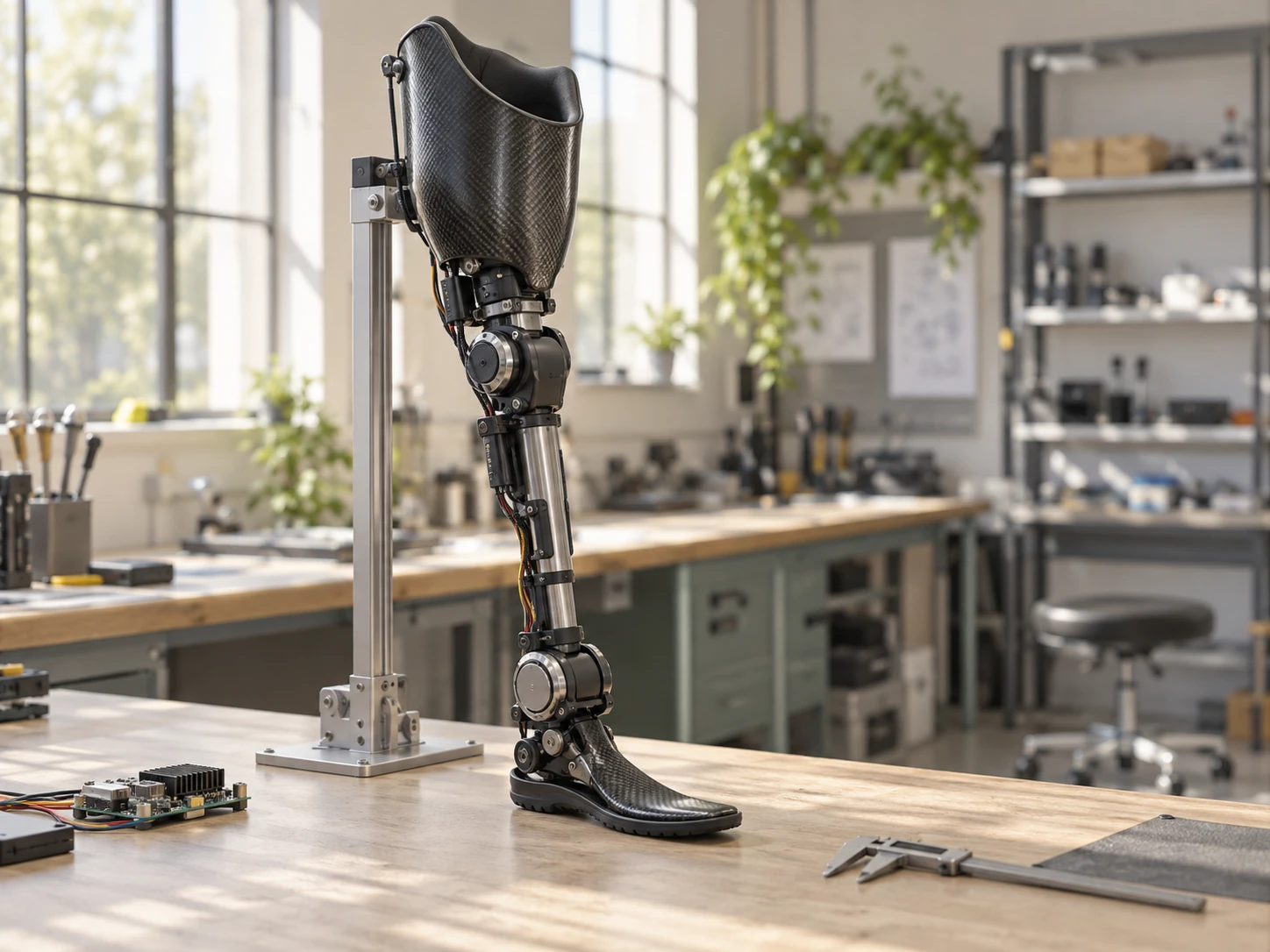
Powered prosthetics
We are developing powered ankle and knee–ankle prostheses that bring together mechanical design, sensing, and adaptive control to support walking.
- Actuation and transmission design
- Gait-phase estimation and embedded sensing
- Coordinated joint control and adaptive assistance
Walking with and without haptic feedback
Sensing-based feedback is another approach to supporting walking, including gait impairments in Parkinson’s disease. These paired demonstrations show two participants, with each recording at its original speed.
Gait rehabilitation research & publications ↗Participant 1
Participant 2
SHARED FOUNDATIONS
Human–robot interaction
Understanding adaptation and designing assistance around the person.
Modeling & digital twins
Combining physical models and data to investigate movement and assistive designs.
Embedded intelligence
Bringing estimation, sensor fusion, and adaptive control into wearable systems.